Pumpfun locks coin metadata while external profiles have separate edit options
Pumpfun locks a coin's launch metadata at creation, so updating an external listing leaves the original launch name unchanged. A creator cannot edit the launch record to point it at replacement metadata. External listings follow their own rules, and content behind a stored link depends on the service that hosts it.
In this guide
Names, media and links perform different jobs
The creation fields give a coin its visible identity, while its metadata address directs applications toward descriptive information, artwork and optional social details. Metadata means the information that describes a token. Its name supplies the full display label; its symbol, or ticker, supplies the short label. The description provides written context, and the image gives applications a visual identifier. A website or community link directs visitors to material outside the token record. Those fields describe the coin without establishing ownership of every account that they mention.
A mint address identifies the actual token on Solana. That address anchors an external profile correction to the existing coin. Names and artwork help recognition, but a provider needs the correct token identity when attaching revised information. Editing a description also leaves the bonding curve and trading fees outside that change.
Can I change my coin's launch details after creation?
Pumpfun makes the metadata submitted during coin creation immutable. The restriction covers the original name, ticker, description, media and social information. Details cannot be added, changed or removed through a later edit to the launch setup. An omitted social field therefore deserves the same attention as a misspelled name. The available alternative concerns information that a separate listing service maintains.
A typo remains in the launch record. Corrected branding on an external profile changes that profile without repairing the original token metadata.
An editing wallet needs actual metadata permission
Update authority means the account authorised to change an editable metadata record; being the launch wallet or holding the token does not automatically establish that permission. General Solana editing tools operate within the relevant token standard's authority rules.
Metaplex metadata
The
create
launch instruction uses a separate Metaplex metadata account. Updating its descriptive data requires an authorised signer and an editable record. An update-authority address alone does not override an immutable setting. A generic editor that accepts a mint address cannot bypass that restriction.
Token-2022 metadata
The
create_v2
instruction uses Token-2022 and stores token metadata on the mint account itself. Its metadata update authority governs changes, and clearing that authority makes the metadata immutable. This storage arrangement differs from the older account structure. Neither arrangement makes a listing-service account an on-chain metadata editor.
External listings offer separate correction routes
A listing service can maintain its own token information independently of the launch record, and its supported fields determine the corrections that it can publish. Some services accept direct profile submissions. Others import information from token lists. Availability and permission belong to the selected service.
Project-account access may be a prerequisite. A correct replacement link does not satisfy a service's verification requirement when the requester cannot provide the required ownership evidence.
Direct profile updates
DEX Screener offers Enhanced Token Info for updating its token-page presentation, including displayed logos and social links. This changes information held by the service. Its scope should be read as a profile update, without assuming that every wallet or explorer will consume the same information.
Token-list updates and imported information
CoinGecko accepts token-information update requests through its self-service portal. Its categories include descriptions, websites, community links and logos. Public announcement links and proof of ownership form part of its verification requirements. DEX Screener also describes importing information from external token lists, including CoinGecko. That provides another information path, with publication depending on the upstream record and its ingestion by the tracker.
Artwork depends on the stored file reference
The token's metadata URI identifies a descriptive document, and that document can identify an image; the permanence of those references differs from the availability of their files. URI stands for uniform resource identifier. The storage method determines what an unchanged reference can retrieve.
Content-addressed uploads
IPFS uses content identifiers, or CIDs, to address stored data. Changing IPFS content produces a different content identifier. A revised image therefore has its own reference. The original metadata document does not automatically adopt that replacement. A published CID also does not guarantee permanent availability: retrieval still requires a node to retain and provide the content.
Files at conventional web addresses
A custom integration can supply a metadata document hosted on a conventional web server. Its operator may change the file served at an unchanged address. That changes externally hosted content without changing the on-chain name, symbol or URI. A fixed token reference alone therefore cannot establish that every file behind it will always be identical.
A fixed social link can reach changing content
A stored social link identifies a destination. The account or website at that destination has separate controls, so a fixed link can show changing content.
Posts and website text can change while the launch record continues to contain the same address. The person who controls that destination controls its published content. Token ownership does not confer control over the linked account. A reachable profile therefore establishes that the address works, without proving continuous ownership or the accuracy of every claim that it displays. Immutable link text cannot preserve an account's moderation, security or posting decisions.
What can I do if a launch link is wrong or missing?
A wrong or missing launch link cannot be corrected in the original creation details, but a supported external listing can publish the intended contact information. When the original website location remains controlled, its content or redirect can help visitors reach updated material. A social service may have different account and address rules.
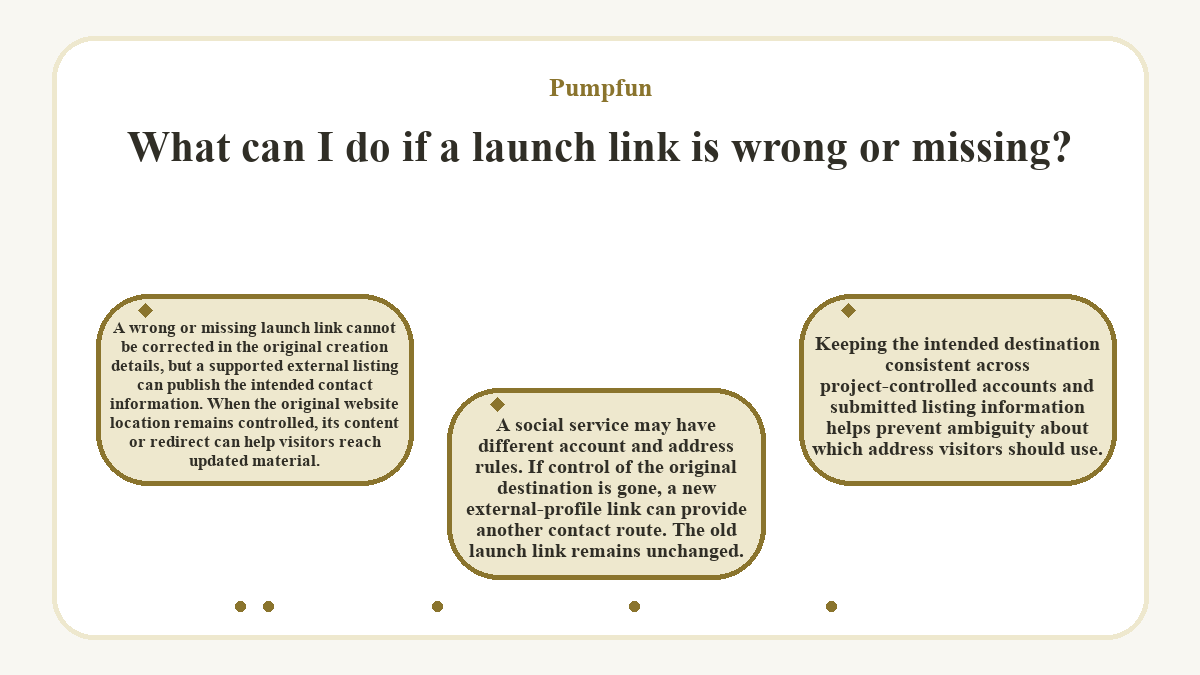
If control of the original destination is gone, a new external-profile link can provide another contact route. The old launch link remains unchanged. Keeping the intended destination consistent across project-controlled accounts and submitted listing information helps prevent ambiguity about which address visitors should use.
Different displays can reflect different data inputs
A revised listing logo does not establish that a wallet will show the same artwork, because applications can draw descriptive information from different records. An application that reads the original token metadata can continue using the launch image. A tracker that maintains a separate profile can display its approved replacement. A tracker that imports a token list depends on that list's published information.
A discrepancy between a wallet and an external profile does not, by itself, show that the update failed. A missing image can also reflect a file-retrieval problem, so absence of artwork alone does not establish that the coin's name or metadata URI changed.
A corrected profile should preserve the existing mint
Consider adding a missing community link to an existing coin's external listing. The aim is a working link on that profile while preserving the token identity. If the selected route requires a project-controlled account, access to that account must exist before the request can satisfy verification.
- The selected listing and request identify the same chain and mint address.
- The proposed community link reaches the intended public account.
- The service supports editing that field on the existing listing.
- The required ownership evidence comes from an account that the project controls.
- The request changes the contact information without substituting another token address.
The smallest change is a request covering the missing link alone. Whether the route is a direct profile submission or an update to an imported token list, the comparison stays the same: the public link for the existing mint. A request confirmation establishes receipt of the submission.
The expected display contains the revised link beside the original mint address. If the observed profile shows that combination and the link opens the intended account, the correction has reached that profile. A changed token address would fail this comparison, even if the artwork looked right. Publication says nothing about future trading demand or account activity.
Creator-fee controls have their own permissions
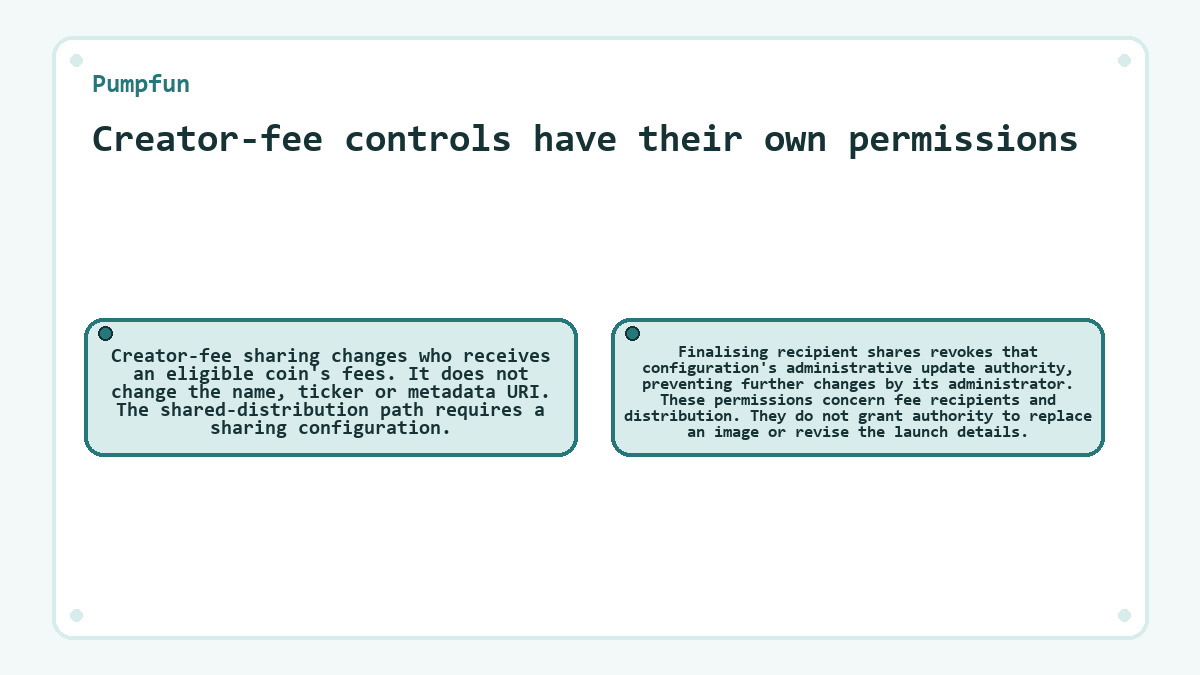
Creator-fee sharing changes who receives an eligible coin's fees. It does not change the name, ticker or metadata URI.
The shared-distribution path requires a sharing configuration. Finalising recipient shares revokes that configuration's administrative update authority, preventing further changes by its administrator. These permissions concern fee recipients and distribution. They do not grant authority to replace an image or revise the launch details.
A different launch identity belongs to a different mint
A new coin can carry a different launch name, ticker or metadata reference, but it has its own mint rather than becoming an edit to the existing token. Existing balances remain balances of the original mint. Reusing artwork or a familiar ticker does not transfer those holdings into the new coin. An external rebranding request can describe a project's changed presentation. It cannot, on its own, create an on-chain replacement or move holders' tokens. Any separate migration arrangement needs its own supported mechanics and terms. For Token-2022 launches, the new mint account carries its own name, symbol and metadata URI.
Answers to common questions
Will a spelling error in coin metadata stop trading?
A spelling error in descriptive metadata does not, by itself, disable trading. The name and description identify the coin, while trading operates through the relevant program and market state. Correcting a tracker description does not alter those mechanics. A mistaken ticker can still create confusion when people search for the token.
How long does an external listing correction take?
An external listing correction follows the selected service's processing and verification requirements. Direct submissions can require review, while imported information depends on upstream publication and the tracker's ingestion. DEX Screener asks users to allow up to 12 hours for Enhanced Token Info processing. CoinGecko lists up to five days for Regular Pass review and review within 24 hours for Fast Pass. These review windows do not guarantee approval or publication in an importing tracker. A submission acknowledgement alone does not establish that the revised information is already public.
Are profile updates included in token-creation charges?
External profile updates are separate services from creating a coin. A listing provider can charge for enhanced information or expedited review under its own terms. Any payment applies to that service's specified scope. It does not purchase permission to edit immutable launch metadata, and a profile update does not change the token's trading fees.
What happens to personal information placed in a launch description?
Personal information in immutable launch data cannot be removed through a normal metadata edit. Exposure depends on its location: on-chain text remains in public records, while off-chain files can persist through storage providers and downloaded copies. Removing an external profile entry does not establish deletion of the original material. Sensitive details should stay out of public launch content.
Must I share a wallet recovery phrase to correct a listing profile?
A wallet recovery phrase should remain private during a listing correction. CoinGecko's verification process uses public project-account evidence and a request identifier. That process does not call for exposing the secret that controls a wallet. A public mint address identifies a token without granting anyone the ability to sign wallet transactions.
Updated on