Pumpfun fees and the costs beyond the trade rate
Pumpfun fees depend on the trading instruction, the coin's fee configuration and whether it trades on a bonding curve or a PumpSwap pool. The total amount required can also include Solana network charges, account funding and fees from a third-party interface. Price impact changes the execution price, while slippage settings limit acceptable execution. These costs need separate treatment because a percentage fee, a network payment and a refundable account balance affect the wallet differently.
Table of contents
Protocol charges, creator shares and pool fees
A trade can contain protocol fees, a creator-related share and, where applicable, a liquidity-provider fee. Those shares describe where trading charges go. They are components of the total trade fee, so adding them again to a fee-inclusive quote would count the same charge twice. Fee settings use basis points; 10,000 basis points equal 100% of the applicable calculation base.
Charges on the bonding curve
Bonding-curve buys and sells use the applicable protocol and creator-fee settings, with the quote asset supplying the denomination. A buyback allocation belongs within the protocol fee; it is not automatically another percentage to add. A creator-related share can go to a designated creator recipient or, on eligible coins, toward holder rewards.
Charges in PumpSwap pools
PumpSwap pools also have a liquidity-provider fee, often abbreviated LP, which enters pool reserves during swap execution. Canonical pools are the migration-created pools associated with completed Pumpfun launches. Their applicable fee tier can change with the coin's market capitalization. Other, non-canonical pools use a separate flat-fee configuration, and both buys and sells carry their applicable swap charges.
Quote amounts, price impact and slippage
Token-target purchases specify a desired token amount and cap quote spending. Exact-quote-input purchases specify a spending budget and an output floor, so the forms protect different quantities.
Fee-inclusive amounts
The quote asset is the asset paid for a purchase or received from a sale. Supported pairs include SOL, USDC and other supported quote tokens. Token-target buys cap the quote payment including trading fees, while exact-quote-input budgets already include those fees. Sells enforce a minimum quote receipt after trading fees. These instruction limits concern the swap itself; network charges and account funding require separate allowance. Costs paid in different assets need conversion to a common unit at the same valuation time.
Price impact and slippage
Price impact comes from the order's effect on the available pricing reserves, while slippage describes execution moving away from the earlier quote. A slippage allowance is an execution tolerance, rather than a fee that a recipient automatically collects. Increasing it can permit a less favorable fill without changing the configured trading percentage. The limit remains specific to the instruction. On Mayhem curve buys using the supported partial-fill option, an exact-input purchase can bypass its minimum-token check when it takes the remaining inventory.
Network fees and account funding
Base and priority charges
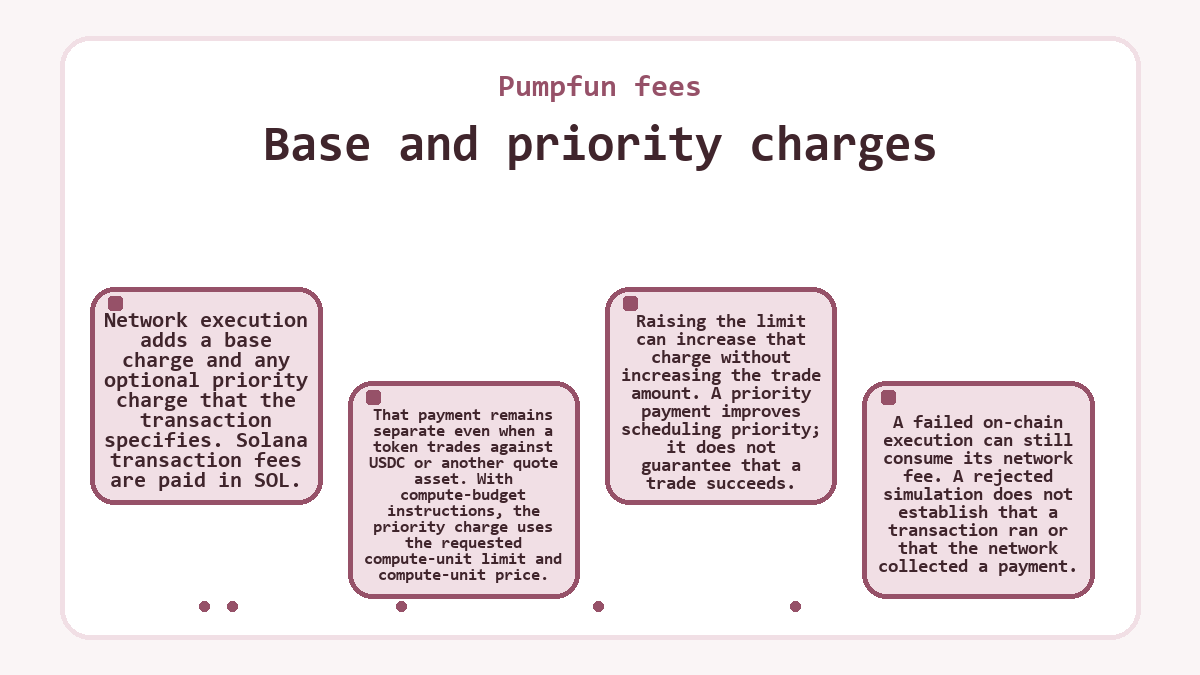
Network execution adds a base charge and any optional priority charge that the transaction specifies. Solana transaction fees are paid in SOL. That payment remains separate even when a token trades against USDC or another quote asset. With compute-budget instructions, the priority charge uses the requested compute-unit limit and compute-unit price. Raising the limit can increase that charge without increasing the trade amount. A priority payment improves scheduling priority; it does not guarantee that a trade succeeds.
A failed on-chain execution can still consume its network fee. A rejected simulation does not establish that a transaction ran or that the network collected a payment.
Account funding and control
Account creation requires a minimum SOL balance based on the account's data size. A trading transaction may also fund a volume accumulator or top up an older curve or pool account. These requirements explain why a first trade can reduce spendable SOL differently from a later trade. Funding a user's own token account and funding a program-controlled account also have different recovery conditions. The person who pays for an account does not automatically control it. Treating all account funding as a refundable personal deposit would overstate the balance available for future orders.
Creation and graduation charges
Coin creation has separate cost rules from trading and migration. A quote showing no platform creation charge can still require network execution and account funding. An initial purchase combined with creation carries its own trading fees. The shared transaction does not turn the purchase into a free operation.
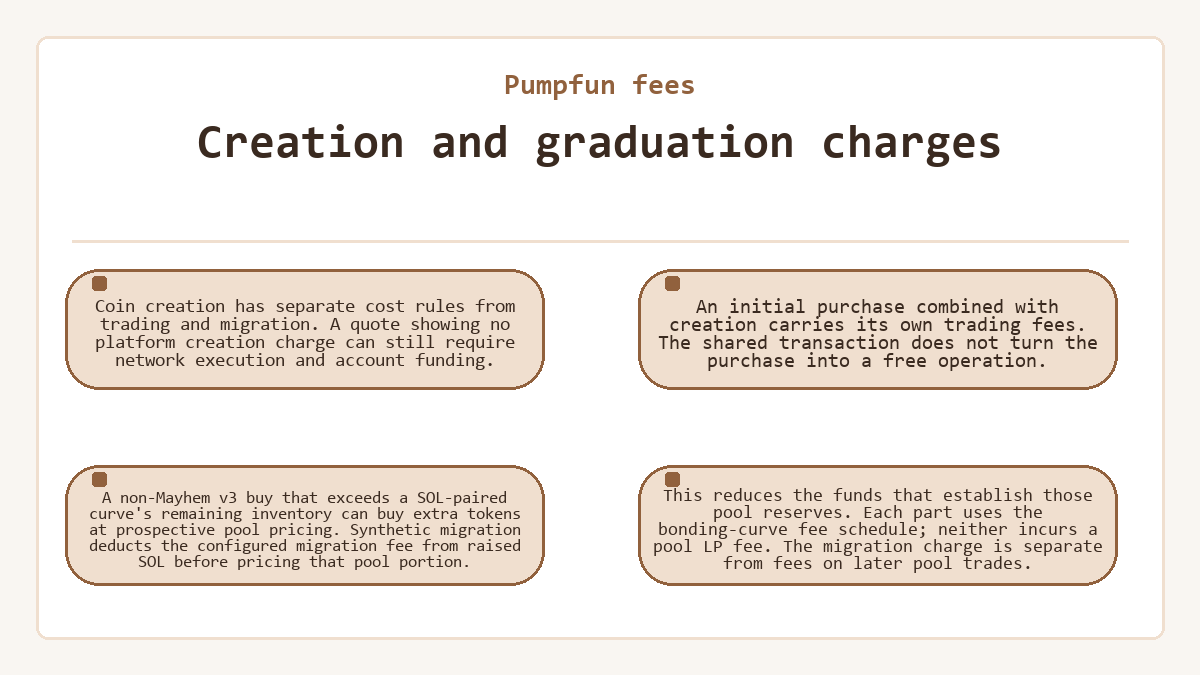
A non-Mayhem v3 buy that exceeds a SOL-paired curve's remaining inventory can buy extra tokens at prospective pool pricing. Synthetic migration deducts the configured migration fee from raised SOL before pricing that pool portion. This reduces the funds that establish those pool reserves. Each part uses the bonding-curve fee schedule; neither incurs a pool LP fee. The migration charge is separate from fees on later pool trades.
Interface costs and the cumulative trading bill
The web trading service does not generally add a separate interface charge to the published platform fees. Some mobile users may face additional fee adjustments on particular transactions, so the ordinary web fee does not describe every mobile charge.
A third-party interface can apply its own service fee alongside protocol fees, and wallet software may also impose separate charges. Changing interfaces can remove or add that service component while the underlying platform fee rules still apply to the trade.
A small order can have a high effective cost because a network payment does not scale directly with its trade value. Repeated buys and sells each add their own applicable charges.
The combined bill for buying and later selling includes both trades, with their separate fee bases and network costs. Applying one percentage to the original purchase cannot describe every deduction. The sale deducts trading fees from its quote proceeds before delivering the net amount, which can differ after a price move. Account funding belongs separately in the cash required to execute, especially where recovery is restricted.
Trading options and enforceable cost limits
Trade instructions give different controls over token output and quote spending. Selecting a purchase form changes which amount can vary as pricing moves. A fee-inclusive maximum input and a minimum output therefore answer different cost questions.
| Trading option | Fee scope and execution control |
|---|---|
| Curve buy with a token target | Maximum quote payment includes protocol and creator fees; partial-fill behavior depends on the instruction and coin mode. |
| Curve buy with a quote budget | Budget includes trading fees; an output floor applies except where a supported Mayhem partial fill bypasses it. |
| Curve sell | Minimum quote output applies after protocol and creator fees. |
| Canonical PumpSwap swap | Applicable fee tier follows pool configuration; input caps and output floors account for trading fees. |
| Non-canonical PumpSwap swap | Separate flat-fee configuration applies, rather than the canonical pool tier schedule. |
| PumpSwap multi-hop swap | Exact input uses one final-output floor; specific fee components attach to the route's endpoints. |
| Third-party interface trade | The interface may add a service charge outside the underlying instruction's trading limits. |
| Cost comparison | Compare the full amount spent or net amount received under the selected instruction. |
PumpSwap's multi-hop instruction combines multiple pool or bonding-curve trades in one call. Every hop must be a buy, or every hop must be a sell. It charges protocol fees on the hop that trades the user's own currency. Creator or holder-reward fees apply at the route's far-end coin, with an LP fee if that hop uses a pool. Intermediate hops do not add those fees. The route uses a single final-output check. Its pool hops require canonical pools; Mayhem curves and pools are excluded. Existing cashback coins are allowed only on the first hop of a buy route or the last hop of a sell route.
Fee tiers and the destination of rewards
The active fee configuration determines a tier's rate and its split. The market-cap input uses token supply and reserve-based pricing, while the configuration supplies the applicable tier thresholds. Pools priced in SOL and USDC use their own applicable denomination and schedules. A dollar valuation does not directly identify the tier of a pool priced in SOL. Custom quote pairs can also have creator-fee settings that need separate treatment. The program applies its fee rules at execution, so an earlier displayed quote does not establish the final charge.
Regular creator-fee coins direct the creator share to their designated recipient. Holder rewards coins allocate that share to holders through Pumpfun's distribution flow. The reward choice changes the recipient; fee computation remains the same. A trading quote can consequently contain a creator-fee field even when a creator receives none of that amount personally.
Bonding-curve v3 and PumpSwap v2 trades retain accrued protocol and creator fees until a sweep moves them to assigned recipients. Their fee amounts match the preceding supported instruction versions. The buyback portion still transfers during the trade, while the LP fee enters pool reserves. A trade event recording accrued fees does not establish that the recipient's wallet has already received them.
Pumpfun fees: common questions
-
Can account funding be recovered after all tokens have been sold?
- Account funding can be recovered when an eligible token account is closed, although selling its balance does not close it automatically. The owner or designated close authority must authorize closure and choose the receiving account. Ordinary token accounts need a zero token balance; certain extensions impose additional checks. Paying the original funding does not automatically make that payer the refund recipient.
-
What happens to fee rebates on existing cashback coins?
- Existing cashback coins remain tradeable, and their accrued cashback stays claimable. Creation of new cashback coins is disabled. The newer bonding-curve v3 and PumpSwap v2 instructions reject cashback coins. Supported earlier instructions remain available; multi-hop routes allow cashback coins only on the first buy hop or last sell hop.
-
Does sharing creator fees reduce the trading charge?
- No. Creator-fee sharing allocates the existing creator-fee balance among configured recipients. Each recipient's percentage applies to that balance, so sharing does not reduce the trading charge. Later distribution can incur separate network costs.
-
When are fees from newer trades available for a creator to claim?
- Creator fees retained by newer instructions must reach the appropriate creator vault through a sweep before collection. The sweep and collection can run in the same transaction. After graduation, pending fees can remain on both the curve and its pool, so collection needs the applicable balances. Calling a permissionless sweep does not let its caller choose an arbitrary recipient.
-
Are liquidity deposits charged the same fees as PumpSwap trades?
- PumpSwap does not apply its buy-and-sell trading fees to liquidity deposit or withdrawal instructions. Those operations can still require Solana network fees and account funding. A separate buy or sell performed to obtain the assets for a deposit remains a trade with its own applicable charges.
-
How are creator-fee settings adjusted for a custom quote pair?
- Custom-pair creator-fee rates can be adjusted through the community-takeover team. A custom pair uses a quote asset other than SOL or USDC, while SOL and USDC pairs use their standard fee schedules. This is a coin-level fee setting, separate from the trading tolerance that a user supplies for an individual order.
-
Will moving a coin between wallets incur its Pumpfun trading fee?
- A plain token transfer does not execute a Pumpfun buy or sell, so its platform trading fee does not apply. The transaction still needs network fees, and a missing destination token account may need funding. Any transfer-specific conditions imposed by the token's program or mint need separate treatment.
Updated on