Pumpfun connects memecoin launches with bonding-curve trading and PumpSwap
Pumpfun lets users create memecoins without coding and trade existing coins through automated pricing on Solana. A bonding curve sets early buy and sell quotes from reserve balances. Coins that complete this initial stage can migrate into a PumpSwap liquidity pool. Creation defines a token's identity and launch options; trading depends on its paired asset, available liquidity and execution limits. The web interface and mobile app provide access, while supported protocol integrations offer additional methods. Permanent name and ticker choices deserve attention before launch. Creating a tradeable token establishes its market infrastructure, while demand and holder behaviour shape its prospects.
A coin's name and ticker stay fixed after creation, so launch details need attention before the transaction is signed.
Creation and trading share a coin's launch infrastructure
The creation form specifies a coin's name, ticker, media and launch options. Traders find existing coins through search and discovery, then trade against their bonding curve or migrated pool. A creator does not have to independently seed the initial trading liquidity. Creation and an initial purchase can be combined, although they are conceptually different operations.
A quote asset is the asset used to pay for a coin and express its price. The standard web form offers SOL and USDC pairings. The protocol additionally supports listed quote assets and eligible existing platform coins. An unlisted platform coin used as the quote cannot itself be paired with another platform coin or be a Mayhem coin. If its curve is complete but awaiting migration, creating the new coin fails until the quote coin's pool exists.
Launch choices set the identity and reward rules
Name, ticker and launch media become fixed after creation. Social links and banners also belong to the initial coin setup. Errors in those details therefore need correction before launch. The ability to redirect creator fees later does not make the coin's identity editable.
Creator fees and holder rewards
Creator payments and legacy cashback
Coins with standard creator fees allocate them to a designated recipient, with sharing available for other wallets or charities. Existing cashback coins can accrue that fee as rewards for traders using compatible trading instructions. New cashback launches are disabled, while accrued cashback remains claimable. These fees come from trading activity and remain separate from any tokens that the creator buys.
Fees directed to holders
Holder rewards coins allocate that fee portion to holders, who receive payouts in the quote asset. Pumpfun distributes these rewards without a holder claim instruction. The choice cannot be reversed, and eligible existing coins can be converted through a community takeover.
Mayhem Mode alters early supply and activity
During the first 24 hours, eligible Mayhem Mode coins may receive automated bot trades. For a new launch, the creator selects this mode at creation. SOL and quote assets on the protocol's main approved list, such as USDC, support it. A quote admitted only through the custom registry or its own bonding curve cannot support a Mayhem launch. Activity can end earlier under the mode's termination rules. The bot receives additional tokens, changing potential supply as well as activity. It may never select an enrolled coin, and its trades generate no creator fees. Tokens under bot control are burned when the mode ends. If the bot is a net seller and all holders try to sell, some may be unable to sell into the curve once liquidity runs out.
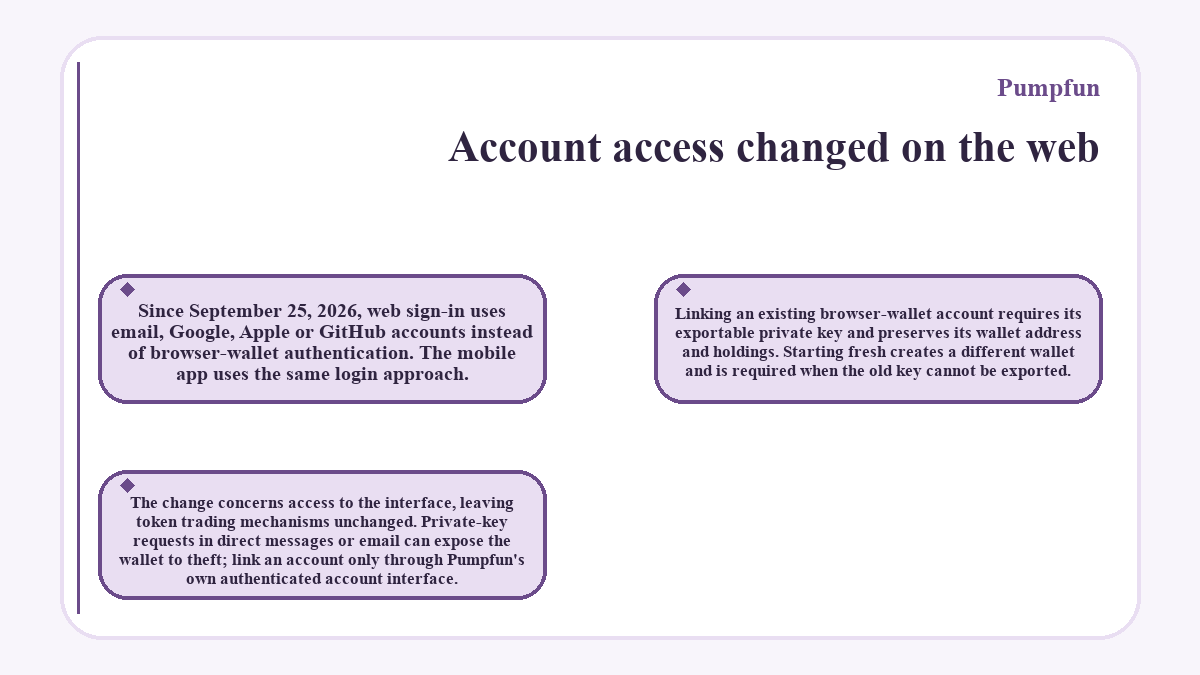
Account access changed on the web
Since September 25, 2026, web sign-in uses email, Google, Apple or GitHub accounts instead of browser-wallet authentication. The mobile app uses the same login approach. Linking an existing browser-wallet account requires its exportable private key and preserves its wallet address and holdings. Starting fresh creates a different wallet and is required when the old key cannot be exported. The change concerns access to the interface, leaving token trading mechanisms unchanged. Private-key requests in direct messages or email can expose the wallet to theft; link an account only through Pumpfun's own authenticated account interface.
Curve completion opens the way to PumpSwap
A bonding curve derives prices from virtual reserves, meaning accounting balances used by its pricing formula. Buys reduce virtual token reserves and raise the price of the next token; sells move the curve in the other direction. These balances differ from the real tokens and quote assets available for exchange. Larger orders move farther along the curve and experience greater price impact.
Graduation requires completing the curve's tradable token inventory, followed by migration into its canonical PumpSwap pool. Canonical here means the pool created by that migration. The liquidity-provider tokens issued for this initial pool are burned. Those tokens represent withdrawal rights over the deposited liquidity. Trading can then continue in the pool, subject to its reserves and trading rules.
For non-Mayhem coins that support v3 buys, the completing purchase can extend into inventory reserved for the future pool. Subsequent curve trades remain blocked until migration creates that pool. Older buy methods retain their own limits and partial-fill behaviour.
Order limits govern the amount that a trade can deliver
Price impact is the change caused by the trade itself. Slippage is the difference between an estimate and execution as prices or reserves move. Exact-spend buys can enforce a minimum token output; exact-token buys can cap the quote amount spent. Sell instructions can require minimum net quote proceeds. The selected trading method determines which protections apply.
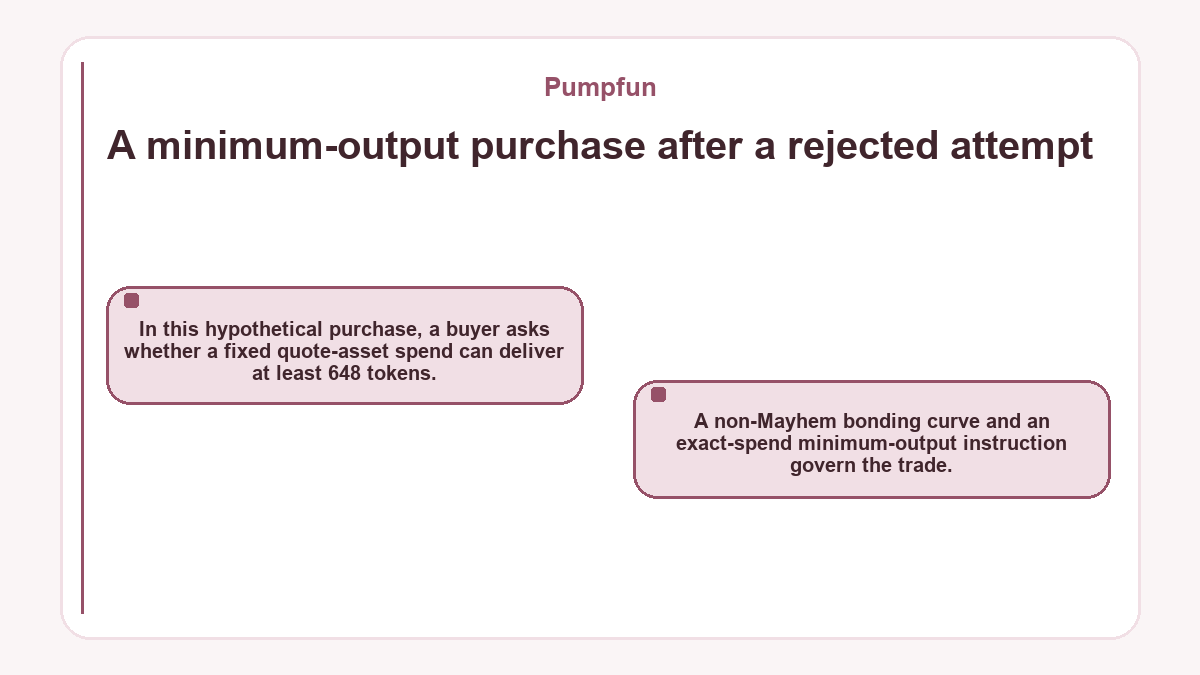
A minimum-output purchase after a rejected attempt
In this hypothetical purchase, a buyer asks whether a fixed quote-asset spend can deliver at least 648 tokens. A non-Mayhem bonding curve and an exact-spend minimum-output instruction govern the trade.
A changed quote blocks the first purchase
Intervening buys change the reserves, reducing the executable output to 638 tokens after trading fees. The program rejects the purchase because it falls below the submitted 648-token minimum. The failed transaction adds no purchased tokens.
Fresh reserves allow the retry to clear its limit
Later sells change the reserves, and a refreshed quote offers 668 tokens for the same spend. The buyer keeps the minimum at 648 tokens. The retry confirms with 668 tokens received, exceeding that minimum by 20 tokens.
Trading fees follow the pair, pool and interface
Trading costs combine the applicable protocol and creator fees, plus any liquidity-provider fee that the pool charges. For canonical PumpSwap pools paired with SOL or USDC, the fee tier depends on market capitalization expressed in that quote asset. Other pool types and custom pairs can follow different rules. The transaction's applicable fee configuration determines its rates.
Solana network fees are paid in SOL, and account creation can add blockchain setup costs. Third-party trading interfaces may add charges, and certain mobile transactions can include an additional fee. Some supported trading instructions retain creator fees and part of the protocol fee on the curve or pool until payout. The buyback portion is paid during the trade. Accrued fees may therefore not yet appear in the recipient's wallet.
Holder distribution and liquidity affect the choice to launch or trade
Concentrated holdings expose a coin to large sell orders that can move its price sharply. The burn of initial liquidity-provider tokens leaves this selling risk intact. Social links and busy trading do not establish durable demand. A token can lose its market appeal even while its trading program continues to function.
A direct PumpSwap pool starts with both assets deposited by its creator. Those deposits set its initial price. A bonding-curve launch establishes early pricing without independently seeding a pool.
Useful questions about Pumpfun
-
Can a coin saved off chain already be traded?
- A coin saved off chain needs its first on-chain purchase before it becomes tradeable in that creation flow. The creator or another buyer can make that purchase, so saving the details does not require the creator to buy the token personally.
-
What identifies a coin when its name resembles another token?
- A Solana token's mint address identifies the asset even when its name, image or ticker resembles another coin. Token balances and trades refer to that mint. Similar branding does not establish that two listings represent the same asset.
-
Are network fees charged when a purchase fails?
- A transaction that reaches on-chain execution can incur Solana network fees even when the purchase fails. The failed transaction rolls back its token exchange, while the network fee can remain charged. A signed request or a failed preview alone is not proof of a charged transaction.
-
How does PUMP differ from coins created by platform users?
- PUMP is the protocol's own token, whereas coins created through the launchpad are separate user-generated assets. Their prices, holders and trading histories are distinct. Holding PUMP does not give a right to protocol revenue or distributions.
-
Does a Mayhem Mode tag prove that the bot is active?
- A Mayhem Mode tag does not establish that the bot is currently trading the coin. The tag can remain after the activity window closes, and eligible coins may never be selected for trading. Termination conditions can also stop the mode before its full activity window ends.
-
Will importing a recovery phrase always select the address holding my tokens?
- A recovery phrase can generate several wallet addresses, so importing it may select a different address from the one holding your tokens. A private key corresponds to one specific wallet address. The recovered public address needs to match the address that holds the tokens.
-
Can the paired asset impose restrictions beyond the platform's trading rules?
- A paired asset can have issuer or listing-provider restrictions that affect trading and eligibility. A freeze, delisting or infrastructure failure can make a curve or pool unusable, including for selling. Listed support applies to the admitted Solana token address, and matching the asset's name does not establish that another version is supported.
-
What are the age and location requirements for using Pumpfun?
- Individuals must be at least 18 years old and have reached the legal age of majority in their jurisdiction. Platform eligibility also excludes prohibited locations and people covered by applicable sanctions. Access to a specific paired asset or restricted feature may require additional eligibility.
Updated on