Pumpfun bonding curve raises token prices as buys change virtual reserves
Pumpfun bonding curve pricing raises the token price when purchases add quote assets and remove tokens from virtual reserves. Larger purchases move farther along the curve, so their average cost exceeds the starting price. Sells move reserves in the opposite direction before completion. Real token inventory determines when the initial curve finishes. Some completing v3 buys can also purchase pool-priced tokens before migration creates the PumpSwap pool. The relevant quote therefore depends on trade size, available inventory and the purchase instruction.
In this guide
A full-order quote accounts for movement along the curve, which a calculation using only the starting token price misses.
Virtual reserves set quotes while real balances limit delivery
Virtual token and quote reserves determine the pricing relationship, while real reserves describe the inventory and funds assigned to the curve. Buyers pay in the quote asset. The ratio of virtual quote reserves to virtual token reserves expresses the token price in that asset. Synthetic reserves allow initial pricing without requiring an equally large deposit of actual quote assets. Those accounting inputs do not represent money that holders can withdraw. The real token reserve tracks the allocation still available for curve purchases. A token account can also hold inventory reserved for the later pool, which has a different role.
A purchase within the real sale inventory can still move the price sharply. Its impact depends on its size relative to virtual pricing reserves. Remaining sale inventory also governs whether a purchase stays entirely on the ordinary curve.
What changes when the bonding curve completes?
Completion closes ordinary curve trading and makes accumulated liquidity eligible for migration into PumpSwap. The program marks the curve complete when its real token sale reserves reach zero. Migration creates the pool that supports subsequent trading. At protocol level, migration is permissionless once the required completion conditions hold. The curve's pricing state and the resulting pool's reserves are separate records. Any purchase that straddles this boundary needs the specific completing-buy rules and a quote that accounts for both pricing portions.
A completed-curve record alone does not establish that a usable trading pool exists.
Trade size separates the starting price from the average price
The reserve relationship
In the continuous, fee-free curve model, the product of virtual token and virtual quote reserves stays constant.
Write the virtual token reserve as X and the virtual quote reserve as Y. Their relationship is
X * Y = k. After adjusting units for each asset's decimal precision, the marginal token price is
Y / X. This describes the price for an infinitesimally small purchase at that reserve state.
The cost of an entire order
A net quote amount a gives a modeled token output of
X * a / (Y + a), provided sufficient real inventory remains for that curve purchase. Buying increases Y and reduces X, raising the ratio between them. The average price across the order is
(Y + a) / X. It exceeds the starting marginal price because the purchase moves through progressively higher prices, while the marginal price after execution represents the cost of a further infinitesimally small purchase at the newly changed reserves.
For an exact-token purchase of q tokens within the curve's remaining sale inventory, the net quote requirement is
Y * q / (X - q). Fees, integer rounding and completion rules still affect the executable quote.
Sells reverse reserve movement before completion
Before completion, selling tokens into the curve increases its token reserves and decreases its quote reserves, lowering the marginal price. The gross quote output follows the changing reserve ratio throughout the sale. A large holding therefore cannot be valued for immediate sale by multiplying its entire balance by the displayed marginal price, because the sale itself moves that price as tokens return to the curve. Actual seller proceeds also reflect trading fees. Returning tokens to the sale inventory can move the curve farther from completion.
Why can the token amount change before a buy executes?
Other trades can change reserve balances between a quote and execution, changing the token output for the same budget. Your own order's movement through the curve is price impact. The difference between the earlier quote and the execution conditions is slippage. Increasing the allowed slippage does not make the curve flatter. It permits a wider change in the executable outcome, subject to the instruction's checks.
An exact-token buy uses a maximum quote cost. An exact-input buy normally uses a minimum token output, with specific partial-fill exceptions. The program rejects a buy that exceeds its cost cap or falls below an enforced minimum token output. A refreshed quote reflects changed reserves; it cannot reserve that price against intervening trades.
A modeled buy followed by a completed-curve handoff
Consider virtual reserves of 86,426 tokens and 36.6 quote-asset units, with enough real sale inventory for the purchase. The buy adds 9.15 quote units to the pricing reserve after fees. All amounts, balances and subsequent states in this example are hypothetical. The calculation ignores integer rounding and isolates the continuous curve mechanism.
The token output is
86,426 * 9.15 / (36.6 + 9.15), or 17,285.2 tokens. Virtual reserves become 69,140.8 tokens and 45.75 quote units. The average purchase price is 25% above the starting marginal price. The marginal price after the purchase is 56.25% above that starting price. A trade record and reserve state showing these amounts would match the expected fee-free movement. Actual program arithmetic would also account for rounding.
Now suppose later trades complete the curve before another purchase reaches execution. An observed completion flag means that the old curve quote no longer describes an available ordinary purchase. Repeatedly submitting that same curve order cannot reopen completed trading. The next quote belongs to the migrated pool once migration creates it. A purchase that crosses completion has its own instruction-dependent treatment.
A successful migration record and its matching pool reserves establish the handoff. The next price calculation uses that pool's effective reserves.
Trading fees sit outside the fee-free calculation
A purchase budget that includes fees differs from the net quote amount that changes pricing reserves. Applying the curve formula to the entire inclusive budget overstates token output. An exact-token buy's maximum cost includes the applicable trading fees. A sell's minimum quote output applies after trading fees. The program rejects the sell if its proceeds fall below that minimum. Fee configuration and any applicable coin-specific settings determine the rate used by the instruction. A remembered percentage cannot establish the cost of a fresh trade. Account funding and network charges also belong outside the reserve-ratio calculation.
V3 trades retain protocol and creator fee balances on the curve until fee sweeps pay them out, while the buyback portion pays out during trading.
The completing purchase can cross into pool pricing
Eligible v3 purchases
On coins that support v3 buys outside Mayhem Mode, a completing purchase can buy additional tokens at the projected PumpSwap pool price. The program first purchases the remaining curve allocation and then prices additional tokens against the reserves intended for migration, with the bonding-curve fee schedule applying to both portions of that same completing purchase. Migration creates the pool with the reserves left after that purchase. The cost cap or minimum output covers both portions. This extension still cannot purchase the pool's entire token reserve.
Inventory-limited purchases
Legacy and v2 buys retain their curve-inventory boundary. Where a partial-fill option is supported, it can stop the purchase at the remaining inventory. Mayhem Mode coins do not receive the v3 extension into projected pool trading. Their oversized purchases fail or buy the remaining curve allocation when partial fill is enabled. A Mayhem Mode v3 exact-input buy with partial fill also skips its minimum-token-output check. These differences affect the purchase that completes the curve; they do not authorize later trades on a completed curve.
Existing cashback coins
Existing cashback coins continue to use supported v2 trading instructions. V3 trades reject that coin type.
Curve reserves and pool reserves need different accounting
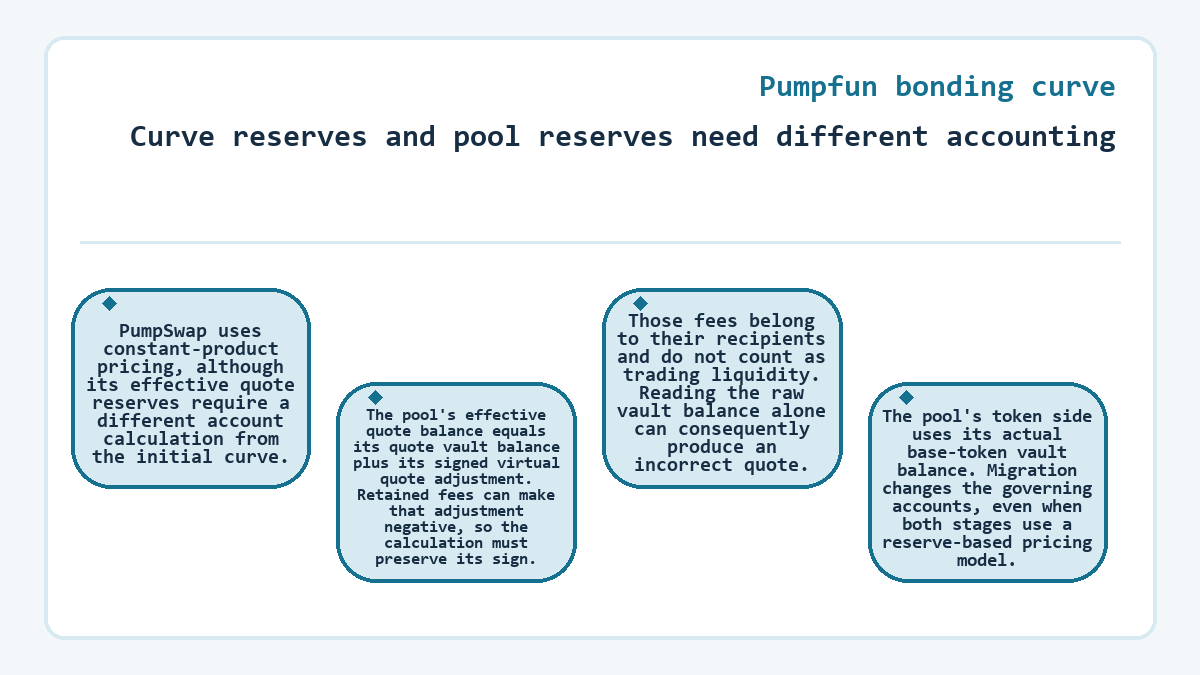
PumpSwap uses constant-product pricing, although its effective quote reserves require a different account calculation from the initial curve. The pool's effective quote balance equals its quote vault balance plus its signed virtual quote adjustment. Retained fees can make that adjustment negative, so the calculation must preserve its sign. Those fees belong to their recipients and do not count as trading liquidity. Reading the raw vault balance alone can consequently produce an incorrect quote. The pool's token side uses its actual base-token vault balance. Migration changes the governing accounts, even when both stages use a reserve-based pricing model.
Market capitalization does not measure exit liquidity
A valuation based on marginal price multiplied by supply assigns that price to the stated token supply. It does not calculate the proceeds from selling that supply. Curve reserves and the trade's effect on those reserves determine a sale quote. Supply, sale inventory and quote liquidity consequently describe different quantities.
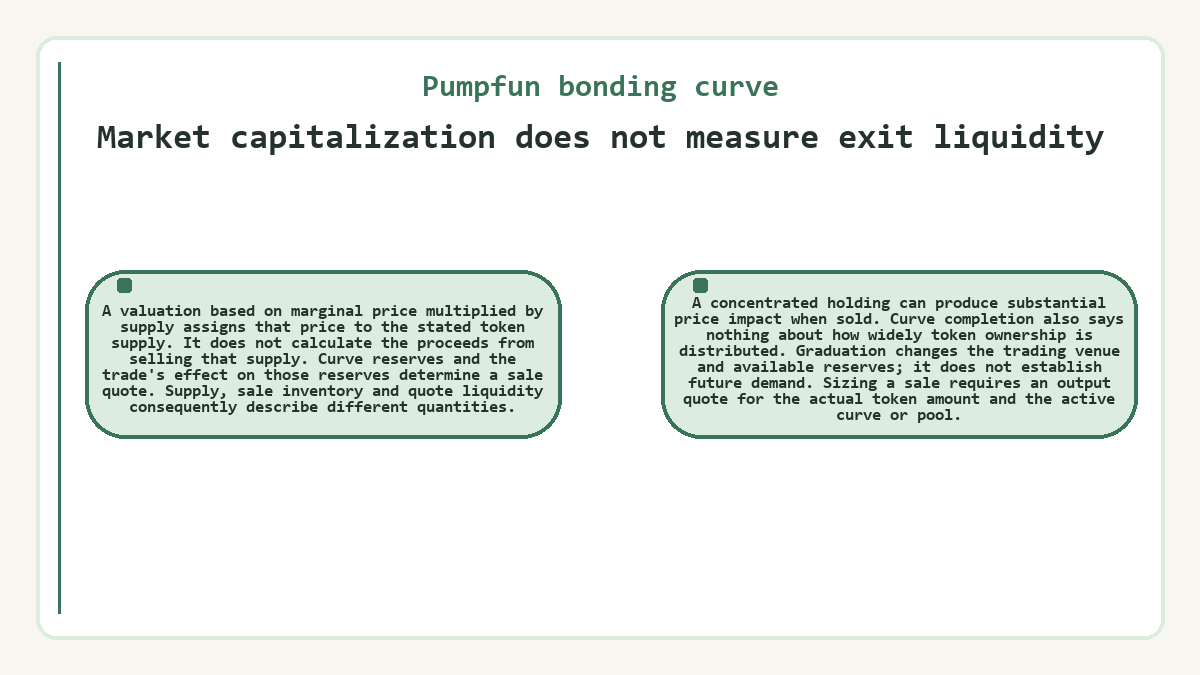
A concentrated holding can produce substantial price impact when sold. Curve completion also says nothing about how widely token ownership is distributed.
Graduation changes the trading venue and available reserves; it does not establish future demand. Sizing a sale requires an output quote for the actual token amount and the active curve or pool.
Pumpfun bonding curve questions, answered
-
Will splitting a bonding-curve buy into smaller orders remove price impact?
- Splitting an order does not remove the combined price impact in an unchanged, fee-free constant-product model. Each portion starts from the reserves left by the previous portion. Without intervening trades, the combined purchase follows the same curve as the original order. Actual results can differ because of integer rounding, fees and other trading activity between submissions.
-
How can raw reserve units distort a calculated token price?
- A ratio of raw reserve integers needs adjustment for both assets' decimal precision. Raw token units and raw quote units can represent different fractions of their displayed assets. Dividing those integers without scaling them can produce a price with the wrong magnitude. The correct conversion uses the decimal settings for the actual token and quote asset.
-
Could transferring tokens between wallets change the bonding-curve price?
- A wallet-to-wallet token transfer does not itself trade against the bonding curve. It changes ownership balances without changing the curve's pricing reserves. A later purchase or sale involving those tokens can change the reserve ratio. A transfer record therefore cannot be treated as a curve buy or sell merely because the token's owner changed.
-
Are all Pumpfun bonding-curve prices denominated in SOL?
- A curve's price is denominated in its configured quote asset, which is not always SOL. Supported pairings include SOL, USDC and eligible Pumpfun coins used as quote assets. Availability follows the coin's actual pairing and the trading instruction that supports it. An argument containing an older SOL-based name can still represent quote-asset units in a unified instruction.
-
Can a token stay below curve completion despite frequent trading?
- Frequent trading can leave a curve incomplete when purchases do not exhaust its remaining sale allocation. Sells return tokens to that allocation while the curve remains open. Trade count alone therefore cannot establish how close it is to completion. The remaining real token reserve and completion state provide the relevant information, and trading frequency cannot establish a graduation deadline.
-
What happens to the token mint when its curve migrates?
- Migration carries the existing token into a pool without replacing its base-token mint. The pool has its own account and liquidity-token mint, which identify different objects. A changed trading account does not mean holders received a replacement coin. Matching the pool's base mint to the original token distinguishes trading infrastructure from the asset that existing wallets hold.
-
Does a quote asset's dollar value affect the displayed token valuation?
- A quote asset's changing dollar value can alter the token's dollar price even when its price in quote-asset units stays unchanged. Dollar conversion adds that separate exchange-rate input to the reserve-derived price. A dollar chart can therefore move for reasons beyond purchases and sales on the token's curve. Reserve math alone establishes the quote-denominated relationship.
Updated on